
Pallets, Racking and Packaging: A Disposal Guide for Fort Worth Warehouses
Not every pallet on your dock is yours to throw away. CHEP’s blue pallets and PECO’s red ones are pooled equipment that stays the company’s property wherever it ends up, and both companies take collection requests. Sort the stack by owner first: only your own pallets are yours to reuse, sell or have hauled.
Call (682) 432-7401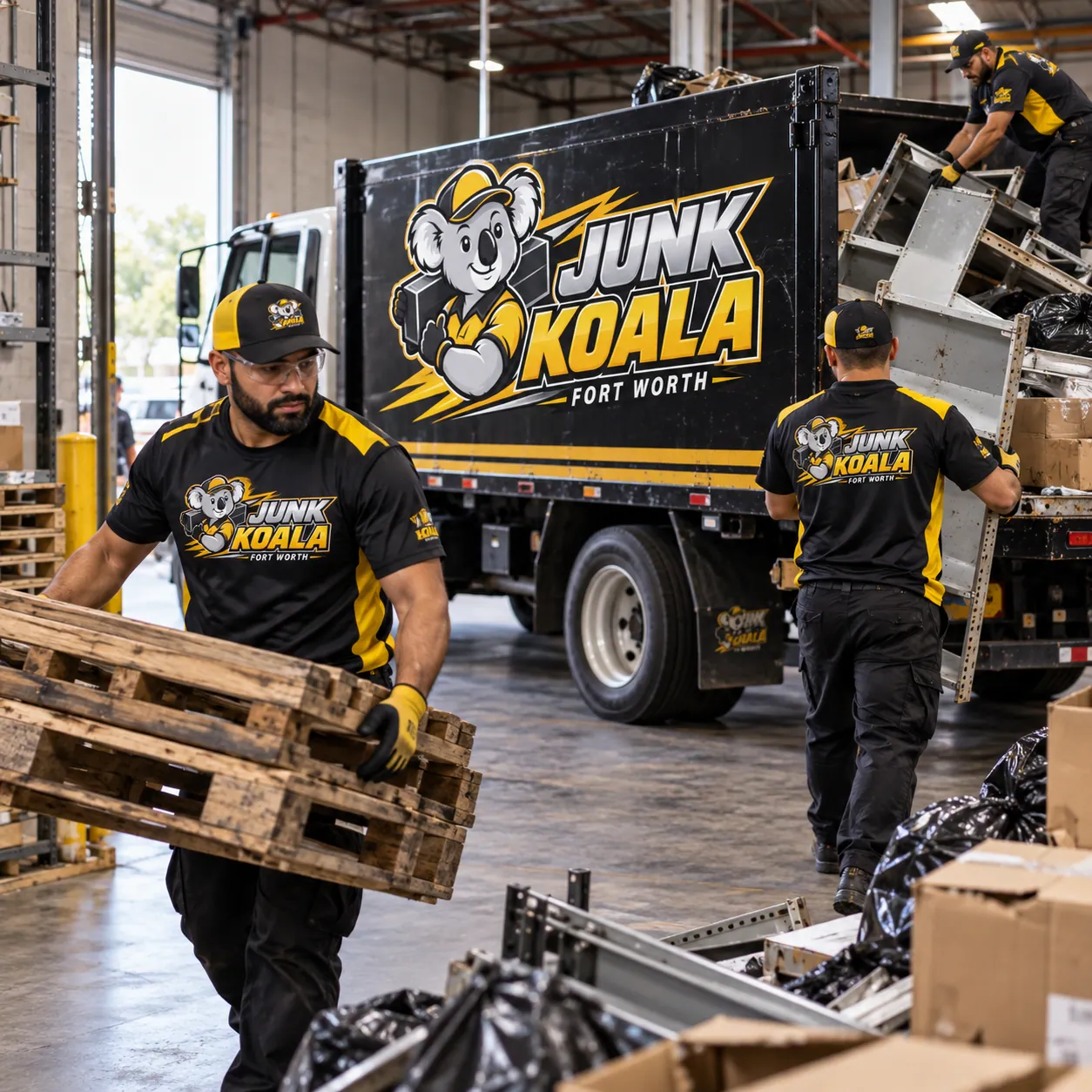
Pallet by pallet
Sort the stack by owner before condition. A pooled pallet is someone else’s equipment, however battered it is.
| Pallet | What to do with it |
|---|---|
| Blue pallets marked CHEP | CHEP’s property wherever they turn up. CHEP says it never sells or gives up ownership of them, and that buying, selling, trading or discarding them is not okay. Request a collection by phone or through CHEP’s online form. |
| Red pallets marked PECO | PECO’s property at all times. PECO says it is illegal to sell, buy, exchange or repurpose them, and wants to hear about even one or two so it can retrieve them. Request a pickup by phone, email or online form. |
| Other branded pallets | A company name branded or stenciled on a pallet is often a sign of pooled equipment. Contact that company before the pallet goes anywhere. |
| Your own pallets, still sound | Reuse them, or offer them to a pallet buyer or recycler. |
| Broken pallets | Hauled as wood waste. Stack them flat and out of forklift lanes until they go. |
What the stamp on a pallet means
Most wooden pallets carry a small stamp, the ISPM 15 mark, showing that the wood was treated to the international standard for wood packaging that moves across borders. A complete mark has four parts: the symbol, a country code, a code for the producer or treatment provider, and a treatment code.
The treatment code is the part people ask about. HT is heat treatment — the wood’s core held at 56 °C or more for at least 30 continuous minutes. DH is dielectric heating, MB is methyl bromide fumigation and SF is sulphuryl fluoride. Methyl bromide is still an approved treatment, although the IPPC encourages alternatives because it depletes the ozone layer.
What the stamp does not tell you is who owns the pallet. That is what the color and the branding are for.
Clearing a dock or a mezzanine
The order that keeps a busy floor safe while the stack comes down.
- 1
Pull out the pooled pallets
Stack them apart from everything else and arrange the owner’s pickup before anything is hauled.
- 2
Stack the broken ones flat
Out of forklift lanes and away from dock doors, where a nail board does the most damage.
- 3
Separate the packaging
Stretch film and cardboard go to whatever recycling or baler arrangement the building has; mixed with pallet wood they are just waste.
- 4
Identify the racking
Light, bolted or free-standing shelving is ordinary removal work. Tall, braced or engineered racking, or anything tied into sprinklers or services, needs a specialist dismantler.
- 5
Book around the dock
Give the hauler your dock times, gate arrangements and any site induction, so the first visit is the only visit.
Business waste has no public drop-off
Warehouse waste cannot go to the city’s routes. Fort Worth’s Drop-Off Stations are for residents, and the city says commercial businesses cannot use them. Its Environmental Collection Center takes residential waste only — commercial, business and industrial waste cannot be accepted under Texas regulations.
So solvents, fuels, oils and drums need a licensed contractor, and everything else that is not hazardous — pallets, packaging, racking, furniture, equipment — goes with a hauler or a recycler.
Where this work happens
The industrial corridors
AllianceTexas, the Meacham Airport area, and the Riverside and Beach Street belts.
Learn moreRecurring warehouse pickups
A fixed weekly or monthly slot for docks that fill up every week.
Learn morePallet removal
Broken and surplus pallets hauled straight from the dock.
Learn moreShelving and rack removal
Light shelving cleared; engineered racking referred to a specialist.
Learn moreFAQ
Related questions
- Can we throw away CHEP pallets?
- No. CHEP says its blue pallets remain its property wherever they are found, and that it is not okay to buy, sell, exchange, trade or discard them; misuse can bring civil liability or criminal penalties. Request a collection instead: call 800-243-7872, option 5, or use CHEP’s online collection form.
- What do we do with red PECO pallets?
- Ask PECO to collect them. PECO says its pallets remain its property at all times and that it is illegal to sell, buy, exchange or repurpose them. Call 1-877-227-7326, option 1, email its recovery group, or use its online pickup form.
- What does HT mean on a pallet?
- Heat treatment. It is the treatment code in the ISPM 15 mark: the wood’s core was held at 56 °C or more for at least 30 continuous minutes. The other codes are DH for dielectric heating, MB for methyl bromide and SF for sulphuryl fluoride.
- Can our warehouse use the city’s Drop-Off Stations?
- No. Fort Worth’s Drop-Off Stations are for residents, and the city says commercial businesses cannot use them.
Read next
Sources
The public rules and figures on this page come from these pages. Programs, limits and hours change, so check the source before relying on a detail.
Ready when you are
You point. We haul. That is the whole arrangement.
Pick a pickup window online, or send a few photographs and get a free quote back first. Homes or businesses, one item or a whole property.
Or call (682) 432-7401
The Fort Worth branch
Junk Koala Fort Worth
2001 Beach St, Ste 524
Fort Worth, TX 76103